See our live dashboard
News › Announcements

Dr Michelle Dalrymple, Mathematics and Statistics Faculty Head at Cashmere High School in Christchurch, is the 2019 Prime Minister’s Science Teacher Winner.

Michelle’s teaching stands out because it is strongly based on cutting-edge mathematics and statistics education research, while maintaining originality, creativity, and fun with strategies that are relevant and inspiring for her students. Read more

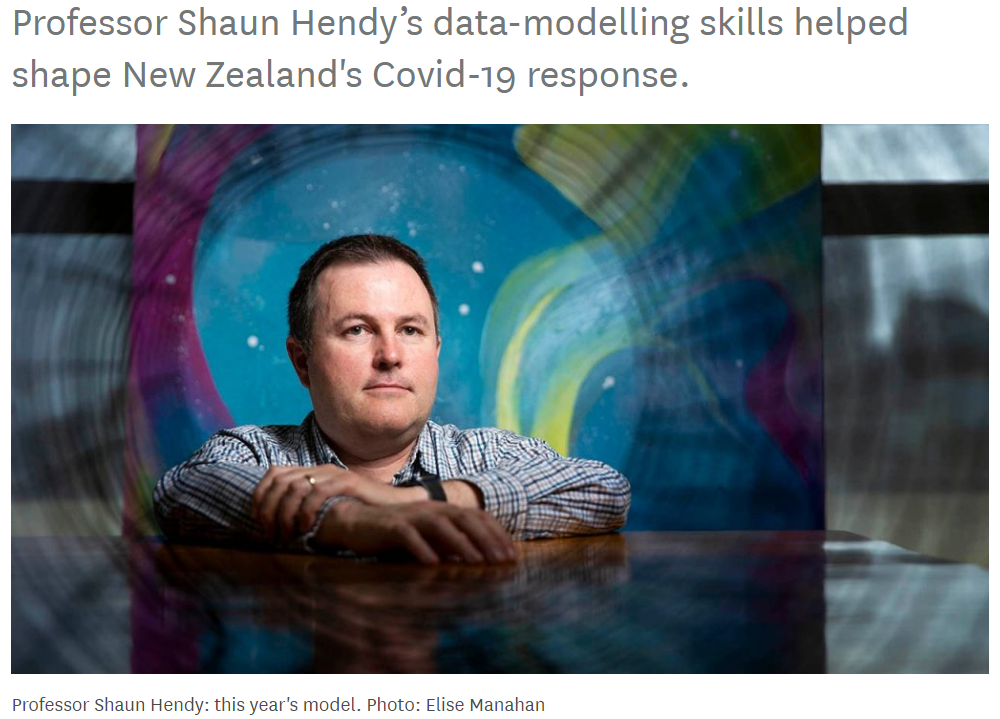
An article about the people behind the scenes of Aotearoa’s response to the Covid-19 pandemic.

Shaun Hendy shares his experiences providing model-based data and recommendations to the government.


What’s the superpower every student needs? Statistics, of course.

Dr. Samuel Echevarria-Cruz, Dean of Liberal Arts, Social and Behavioral Sciences at Austin Community College, and Rob Santos, Vice President and Chief Methodologist at The Urban Institute, led a discussion about how statistics—the science of learning from data—is the new superpower every student needs in their studies and career.

Statistics influences industries as varied as sports, fashion, public health, and more, and continues to increase in its importance and opportunities. In fact, statistician was named the #1 Best Business Job and #6 among the top 100 Best Jobs by U.S. News & World Report.

Now more than ever, it’s a great time to take a statistics class and prepare yourself for a bright future.

Register to watch a replay

The Concord Consortium are organising an interactive webinar on April 29 at 4 PM ET. Register today. Participants will explore Fast Plants genetic data in your three-dimensional instruction. Participants will receive a lesson plan to teach genetic inheritance patterns and a certificate for one hour of continuing education credit.

See CODAP latest news and happenings: Covid-19 in the US

https://mailchi.mp/concord/april-2020-dse-enews?e=e9cd617879


This is Statistics are celebrating Mathematics & Statistics Awareness Month with a month-long series—meet a statistician in a Facebook Live AMA every Thursday through the end of April. Learn more about this series and the first statistician, Sam Echevarria, here: https://thisisstatistics.org/mathematics-statistics-awareness-month-meet-a-statistician-series


Credit Amalia Bastos

Publishing in Nature Communications, PhD candidate Amalia Bastos and Associate Professor Alex Taylor carried out an experiment to test New Zealand’s alpine parrots (Nestor notabilis) on their ability to make predictions using statistical, physical and social information in a similar way to a human. Read the full article…

The Concord Consortium hosts a number of data science games and projects for Year 9 – 13 students. CODAP makes data science accessible and empowers students to understand and analyze complex data without hours of coding lessons or years of advanced mathematics. A new collection of Dynamic Data Science activities is now available to get students working with data!

Also check out:

If you are involved in any citizen science projects around Aotearoa, let CensusAtSchool know about your project.

PS: Did you know the R coding language was created in New Zealand!

A few teachers have contacted us with questions and feedback about Question 1 in the questionnaire which asks if students are male or female, so in this email, I’ll explain more to everyone.

Firstly, it is great that you and your students are thinking and talking about the questions and answers! This is an important part of survey design.

Some of our CensusAtSchool questions match word-for-word with the official Census questions. This means that we use tried-and-tested and familiarly worded demographic questions which have been tailored to the New Zealand context, such as asking birth country and ethnicity.

Many people assume that the first question we ask (and that the official Census asks) is about gender identity. However, it is asking about biological sex.

It is easy to get these mixed up as the question itself does not say either one in the wording!

Added to that, there has been a tradition of using the word ‘gender’ in school environments when we really mean ‘sex’ because of the long-recognised problem of many kids getting silly whenever the word ‘sex’ is mentioned.

Now that gender identity has come much more to the forefront of society’s attention, this common educational workaround is now creating its own problems which will take time to fully solve.

Currently, the official definition Stats NZ uses for biological sex is binary. In the last two years, Stats NZ has tested adding a third response option using either ‘indeterminate’ or ‘intersex’. Of these tests, Stats NZ said the data was of very low quality and included facetious responses and responses made in error:

“Given the very low prevalence of the intersex population, the test results indicated that inaccurate responses for a third category would be as common as – or outnumber – legitimate responses for this category.”

If one of your students is intersex, I recommend they do not answer Question 1 for CensusAtSchool. Stats NZ advice was for people to request a paper copy of the census and then to check both boxes on the form.

Currently, gender identity is not yet asked in the official census and is not asked by CensusAtSchool. It is also not yet asked in other countries official census.

Stats NZ wrote that the reason not yet to ask gender identity is purely for statistical reasons:

“Our testing did not give us confidence we could collect quality information on these topics through the census. Writing census questions is complex and demands a great deal of expertise and testing to ensure the answers provide meaningful, high-quality data that can be used to inform decisions.”

This page is an excellent summary of the issues and the work being done in this area:
https://www.stats.govt.nz/reports/sex-gender-and-sexual-orientation

I hope this helps in some way towards your understanding.

The only national survey to comprehensively chart children’s views of their own lives is taking place across New Zealand from March 4. This year, we will learn from Kiwi kids on issues as wide-ranging as climate change, the amount of time they spend on digital devices, how they handle interpersonal issues, and their own attitudes and perceived parental attitudes to activities such as drinking and smoking by young people. Preview the questions in English and te reo Māori here.

CensusAtSchool New Zealand, known in te reo Māori as TataurangaKiTeKura Aotearoa, is a non-profit, online educational project that aims to bring statistics to life in both English and Māori-medium classrooms. Supervised by teachers, students from years 5-13 anonymously answer 30 questions in English or te reo Māori, and later explore the results in class. CensusAtSchool runs every two years, and in 2017, more than 32,000 students took part, representing 534 schools and 1,062 teachers.

CensusAtSchool, now in its ninth edition, is a collaborative project involving teachers, the University of Auckland’s Department of Statistics, Statistics New Zealand and the Ministry of Education. It is part of an international effort to boost statistical capability among young people, and is carried out in Australia, the United Kingdom, Canada, the US, Japan and South Africa. The countries share some questions so comparisons can be made.

2019 Ihaka lectures

Rise of the machine learners:

Statistical learning in the computational era

Don’t miss this set of four lectures held from March to April. Get a group together, invite your  colleagues from other departments, or take your stats scholarship students. See the program: IhakaDLE19.