P Y6 Biased Bingo new
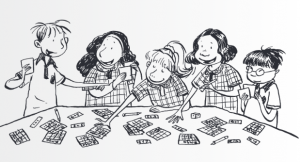
WHAT HAPPENS in Biased Bingo?
In this unit, students devise bingo cards which they believe will give them the best chance of winning a game of addition fact bingo.
Students will:
- Familiarise themselves with the game of bingo. (Discover)
- Use their understanding about addition facts to identify which numbers will not occur (according to the game’s rules). (Discover, Devise)
- Record the frequency with which the other numbers are expected to appear. (Devise)
- Construct a bingo card which they feel has the greatest likelihood of winning a game. (Develop)
- Test and reflect upon their decisions. (Defend)
Learning goals
- Conducting repeated probability experiments or games, identifying the outcomes, and describing differences between them using probability vocabulary.
- Exploring probability beyond coin tossing and dice rolling.
- Exploring a probability experiment where the theoretical probability of a certain outcome can be calculated.
- Make predictions based on data collected.
- Identify all possible outcomes of an event.
- Assign probabilities to simple events using fractions (1/2, 1/6, etc).
Resources
- Biased Bingo (Maths inquiry unit of work)
- Photocopy masters are within the handout
- A set of 30 standard 4×4 Bingo cards (rather than the suggested 5×5) can be found here
Activity
Biased Bingo
This unit of work from the IMPACT team https://www.mathsinquiry.com/ is structured according to the 4D Guided Inquiry process for mathematical inquiry. This unit, Biased Bingo, explores the idea of making a fair bingo card when the calling cards are basic addition facts.
This work might take more than two sessions, a suggested split is:
Session 1: Discover and devise
Session 2: Develop and defend